Diamond Cut Grade: Excellent vs Ideal
Of the four Cs, the diamond cut grade is the only one that measures a human decision rather than an accident of geology. Color and clarity describe what a stone arrived as. Cut describes what a cutter chose to do with it.
Which is why the cut line on a grading report is the one most worth reading slowly. It is also the one that confuses people most, because two of the most common words in diamond shopping, Excellent and Ideal, do not come from the same place and do not mean the same thing. One is a grade issued by a laboratory. The other is, depending on who is using it, either a different laboratory's top grade or a retailer's in-house marketing term. Knowing which you are looking at changes what you are willing to pay for it.
What a Diamond Cut Grade Actually Measures
A diamond cut grade is a single score summarising seven separate measurements of how a round brilliant handles light and how well it was made. According to GIA's own explainer on the cut grade, the institute spent 15 years developing that system, modelling tens of thousands of proportion combinations and backing the result with more than 70,000 observations of real diamonds by real people.
The seven components fall into three groups, and they are worth knowing by name because a grading report will not spell them out for you:
- Brightness. The total white light the stone returns to your eye.
- Fire. The flashes of spectral color as white light splits into its wavelengths.
- Scintillation. The pattern of sparkle and contrast as the diamond or your hand moves.
- Weight ratio. Whether the stone's weight is justified by its face-up size, or hidden in a thick girdle.
- Durability. Whether the proportions leave the stone vulnerable at the girdle or culet.
- Polish. The surface finish left by the cutter, graded separately.
- Symmetry. The precision of facet alignment, also graded separately.
The rule that matters is this one: GIA takes the lowest rating the stone receives across five of those seven components and makes that the overall grade. Polish and symmetry are reported on their own lines. That is why, as GIA notes, a diamond with Very Good polish or symmetry can still carry an Excellent cut grade. The overall word on the report is a floor, not an average.
Excellent vs Ideal Cut: Why GIA Never Says Ideal
GIA's cut scale has five grades, Excellent through Poor, and it deliberately does not include the word Ideal. In its history of cut quality grading, GIA states plainly that the scale omits the term Ideal, because a single prescribed set of proportions was never the goal. The system launched in January 2006 and rests on six rounded proportion parameters that together describe more than 38 million possible combinations. A great many of those combinations earn Excellent. There is no one right answer.
Ideal, by contrast, entered the vocabulary through the American Gem Society, whose laboratory used a 0 to 10 performance scale where zero is Ideal. GIA acquired the AGS technology and intellectual property at the end of 2022. So when you see Ideal today it usually means one of three things: a legacy AGS grade, a lab using its own house scale, or a retailer's internal selection standard. None of those are wrong. They are simply not interchangeable with a GIA Excellent.
| Cut grade | Where it sits on GIA's scale | What you tend to notice face-up |
|---|---|---|
| Excellent | Top of five | Even distribution of light and dark, vivid color flashes held together with overall brightness |
| Very Good | Second | Very close to Excellent in most rooms; slightly softer contrast under low light |
| Good | Middle | Brightness holds in strong light but flattens in softer, indoor conditions |
| Fair | Fourth | Visible light leakage through the pavilion; the stone can read glassy |
| Poor | Bottom | Dull or dark zones; weight is working against light rather than with it |
GIA's guidance on where to land is unusually direct for a research body. "If you want maximum brilliance and fire, choose a diamond with an Excellent cut grade," the institute advises in its six things to know about cut. We agree, with one caveat below about where the rest of your budget should go.
Where Cut Grade Should Sit in Your Budget
Cut is the one grade we would never trade down, because it is the only one you can see from across a room. Color and clarity are inspection-range qualities. A near-colorless stone set in yellow gold reads white; an eye-clean SI1 reads flawless at arm's length. A soft cut reads soft from the doorway. If you are deciding between a half grade of color and a step of cut, take the cut every time, then read our diamond clarity chart guide to find the eye-clean line and stop paying past it.
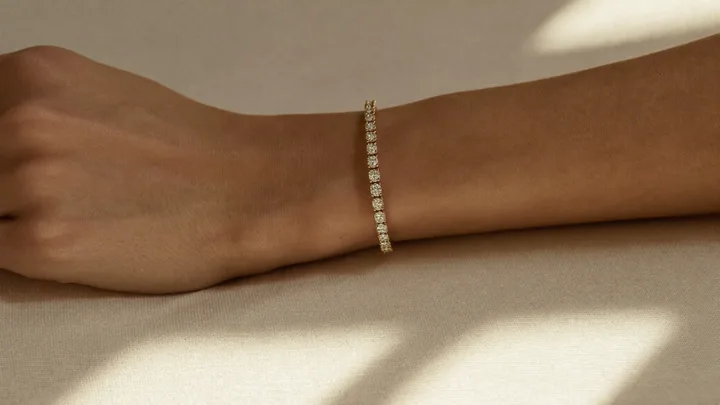
That logic shows up in how our round brilliant pieces are built. The Aurore Round Diamond Tennis Bracelet (from $1,450) runs a line of precision-cut rounds where consistency of light return across every stone matters more than any single stone's size. The Halo Round Diamond Pendant (from $850) uses the same principle in miniature, a continuous loop where a single dull stone would break the circle. For a solitaire-style moment on the ear, the Three Stone Diamond Stud Earrings (from $450) put three rounds in a row, which is the most unforgiving test of matched cutting there is.
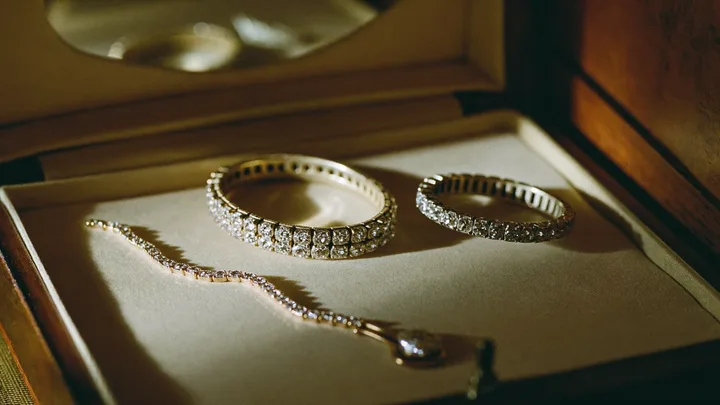
At the band end, the Linear Diamond Half Eternity Band (from $700) and the Cascade Diamond Drop Earrings (from $450) show the other reason cut consistency pays: in multi-stone settings, the eye reads the weakest stone first. Every lab-grown diamond we set is IGI and Roomy's certified, in solid 10, 14 or 18kt gold.
Why Cut Grade Is Getting More Scrutiny in 2026
Cut has become the deciding grade because lab-grown diamonds removed scarcity from the other three. National Jeweler, reporting The Knot's 2026 study, puts lab-grown stones at 61% of engagement rings, with lab-grown engagement ring sales up 31% over the period while finished natural diamond ring sales fell 4%. When a D color VVS stone is within reach of an ordinary budget, color and clarity stop functioning as status signals and craft becomes the differentiator.
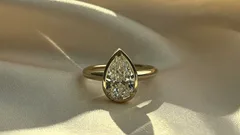
Grading science is moving in the same direction. GIA's Fall 2024 Gems & Gemology research on fancy shapes observed 683 ovals, 430 pears and 308 marquises in pursuit of a cut grading framework for shapes that have never had one. Its conclusion is a useful warning for shoppers: "It is clear that the cut grading methods applied to round brilliants cannot be simply transferred to fancy-shaped diamonds." If you are buying anything other than a round, the word on the report is doing less work than you think, and your own eye has to do more. Our guide to pear shaped diamond rings works through exactly what to look at instead, on the fancy shape gaining ground fastest this year. The same caution applies to the soft-cornered antique shapes, which is why our cushion cut diamonds buyer's guide explains which measurements to read when no cut grade is doing the work for you.
Frequently Asked Questions
Is an ideal cut diamond better than an excellent cut diamond?
What is the best diamond cut grade for sparkle?
Does cut grade matter more than clarity or color?
Do lab grown diamonds get the same cut grade as natural diamonds?
Cut First. Everything Else Second.
Every lab-grown diamond we set is IGI and Roomy's certified, cut for light return and hand-finished in solid 10, 14 or 18kt gold.
Shop the Collection