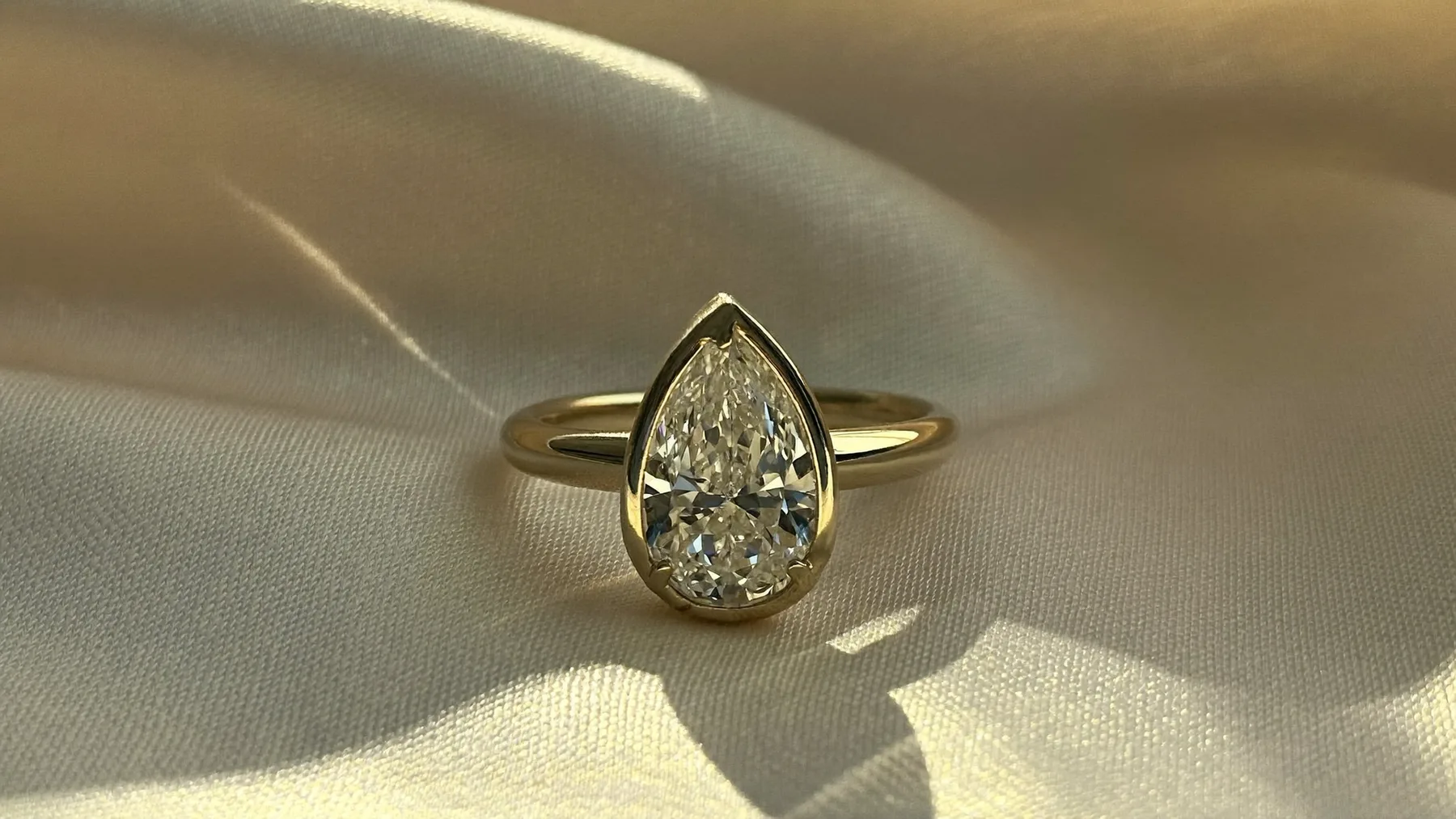
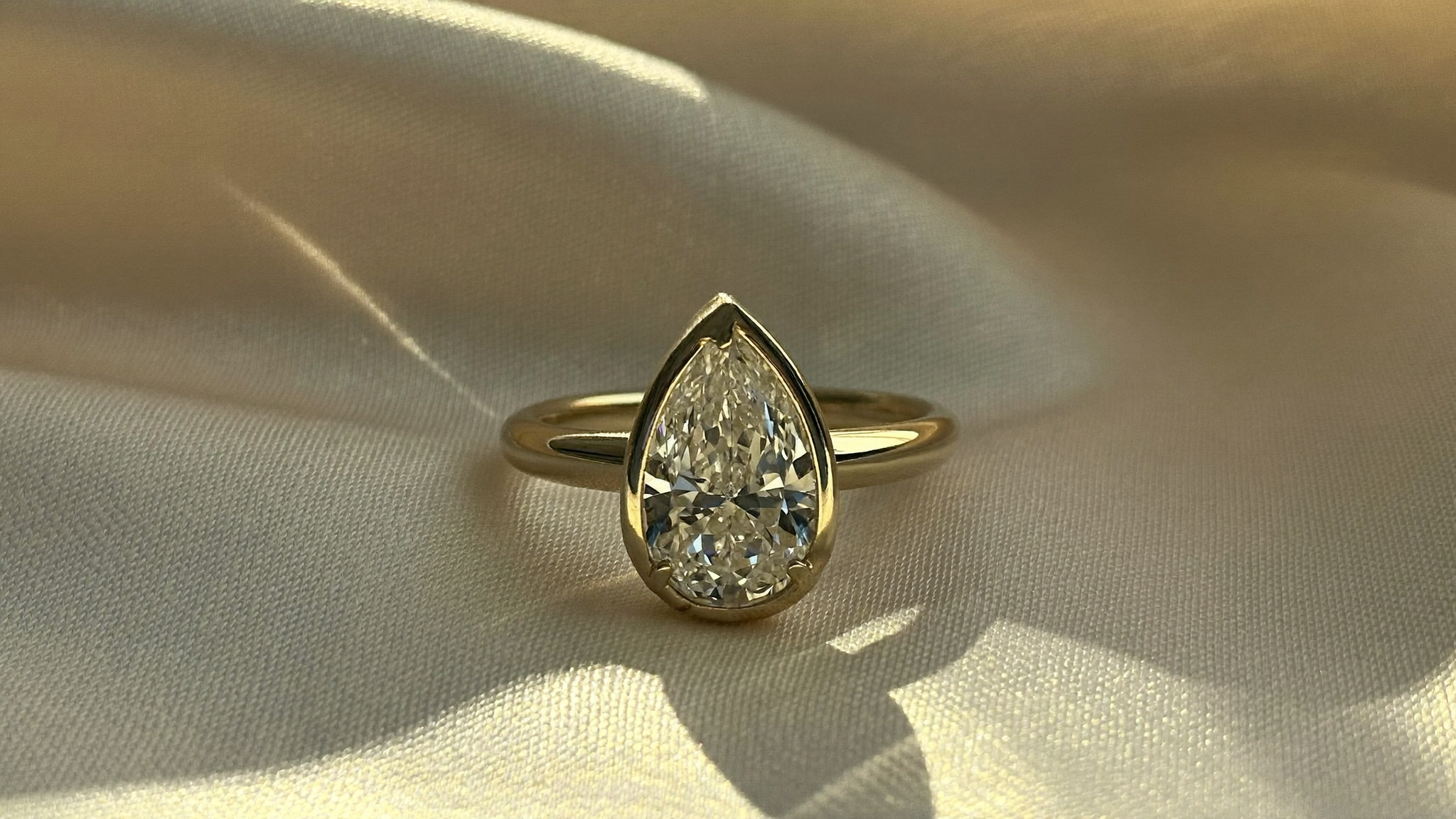
Pear Shaped Diamond Rings: The Teardrop Year
The pear shaped diamond ring has spent two decades as the shape people admired on other people. In 2026 it reads as a first choice rather than a departure from one.
Part of that is arithmetic. Elongated shapes cover more finger per carat, and once lab-grown stones made carat weight affordable, the question stopped being how big and started being what silhouette. The pear answers it with a shape no other cut can borrow: one rounded head, one sharp point, and an axis that runs with the finger instead of across it.
Why the Pear Shaped Diamond Ring Is Having Its Moment
Pear shaped diamonds now sit level with emerald, marquise and princess cuts at 8% of engagement rings, according to The Knot's 2026 jewelry and engagement study as reported by National Jeweler. That is a meaningful position in a market where round and oval take 26% and 25% respectively and everything else divides the remainder.
The trade has watched the shift happen in order. Ryan Miller of Brent Miller jewellers told Rapaport that "Fancy shapes in general are definably more popular these days," describing a sequence that moved from oval to pear and on toward marquise. Margaret DeSalvo of C.D. Peacock, speaking in the same report, explained the appeal in physical terms: pear and oval cuts present a larger surface and sit more elongated on the finger.
There is a lab-grown dimension too. The Knot's study puts lab-grown diamonds at 61% of engagement rings, and National Jeweler reports lab-grown engagement ring sales rising 31% in the same period. When a two carat stone stops being a stretch, buyers start spending their attention on shape and setting rather than on carat alone.
The Teardrop, Defined: Ratio, Shoulders, and the Bow Tie
A pear shaped diamond is a hybrid cut with a rounded head at one end and a single sharp point at the other, combining the brilliant faceting of a round with the elongated outline of a marquise. Everything you need to judge one lives in four measurements, and none of them appear as a single word on a report.
- Length to width ratio. GIA notes that many experts prefer a ratio of roughly 1.50 to 1.75 to 1. Below that the stone reads oval; above it reads needle-thin.
- The bow tie. A dark band running across the width of the stone from the centre of the table. GIA says a well-cut pear shows only a minimal bow tie with good contrast between light and dark areas.
- Shoulder symmetry. The two curves either side of the head should mirror each other. Flat or uneven shoulders are the most common giveaway of a rushed cut.
- The point. It should sit on the exact centreline of the stone, not drift to one side, and it needs protecting in the setting.
The bow tie is the one worth labouring. GIA observes that it intensifies as the gap between length and width grows and as pavilion angle variations become more extreme, and that it can range from light grey to near black. The larger and darker it is, the more it takes from the stone face-up. There is no grade for it. You look.
Pear vs Oval vs Marquise: Reading the Elongated Shapes
Pear, oval and marquise all elongate the finger, but they are not graded or made with equal ease. GIA's Fall 2024 Gems & Gemology research on fancy cut grading observed 683 ovals, 430 pears and 308 marquises while building a modelling framework, and found that the shapes demand wildly different levels of description: a four-main oval can be modelled with 18 parameters and a four-main marquise with 19, while a four-main pear needs 35. The pear is, quite literally, the hardest of the three to define.
| Shape | Typical length to width | Silhouette on the hand | Parameters to model it |
|---|---|---|---|
| Pear | 1.3 to 1.8, with 1.50 to 1.75 often preferred | Directional. One rounded end, one point, reads longest of the three | 35 |
| Oval | Submitted ovals peak near 1.4 | Symmetrical and forgiving, elongates without drawing a line | 18 |
| Marquise | Varies by house | Two points, most dramatic, most fragile at both ends | 19 |
That complexity is why GIA researchers concluded that "Each fancy shape merits its own tailored approach to cut quality grading" rather than borrowing the round brilliant system wholesale. In practical terms it means the cut line on a pear's report carries less information than it does on a round. If you want the background on how that round brilliant system works and why its top grade is Excellent rather than Ideal, our diamond cut grade guide walks through all seven components.
How to Wear a Pear Beyond the Engagement Ring
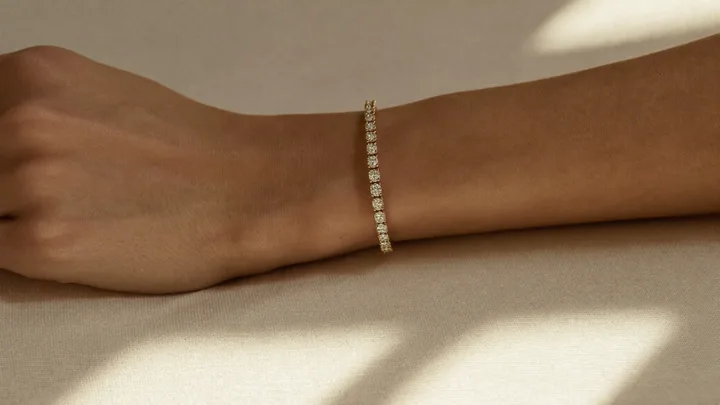
The pear is the rare fancy shape that works as well in multiples as it does alone, because the point gives a repeated line somewhere to go. The Lumiere Pear Diamond Tennis Bracelet (from $6,550) carries two carats of pear-cut diamond around the wrist, each stone angled so the points chase one another rather than sitting static. It is the clearest argument we make for the shape.
At the neckline, the Starlight Portal Diamond Necklace (from $1,700) frames an open centre with radiating pear and round stones, which puts the elongation where a V-neckline already draws the eye. Its matching Starlight Portal Diamond Stud Earrings (from $1,500) do the same at a smaller scale.
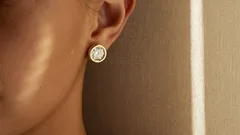
For a quieter entry point, the Blossom Grace Mismatched Diamond Earrings (from $350) use deliberately unmatched petals so the pear reads as a shape rather than a statement. The Diamond Bow Stud Earrings (from $1,650) set pear, emerald and baguette diamonds together, which is the best demonstration we have of how differently the three cuts handle the same light. If step cuts are where your eye keeps landing, our emerald cut guide covers that side of the shape conversation. Every stone is lab-grown, IGI and Roomy's certified, set in solid 10, 14 or 18kt gold.
Frequently Asked Questions
Are pear shaped diamonds still in style in 2026?
What is the best length to width ratio for a pear shaped diamond?
Which way should the point of a pear shaped ring face?
Are pear shaped diamonds more fragile than round diamonds?
The Shape That Runs With the Finger
Pear-cut lab-grown diamonds, IGI and Roomy's certified, set point-protected in solid 10, 14 or 18kt gold.
Shop the Collection