Sculptural Rings: Jewelry as Wearable Art
For most of the last decade, a ring's ambition was measured in carats. In 2026 that changed, quietly and for an unromantic reason: gold got so expensive that the only way left to make an impression was to make a better shape. Sculptural rings are what happened next, and they are the most interesting thing on hands right now.
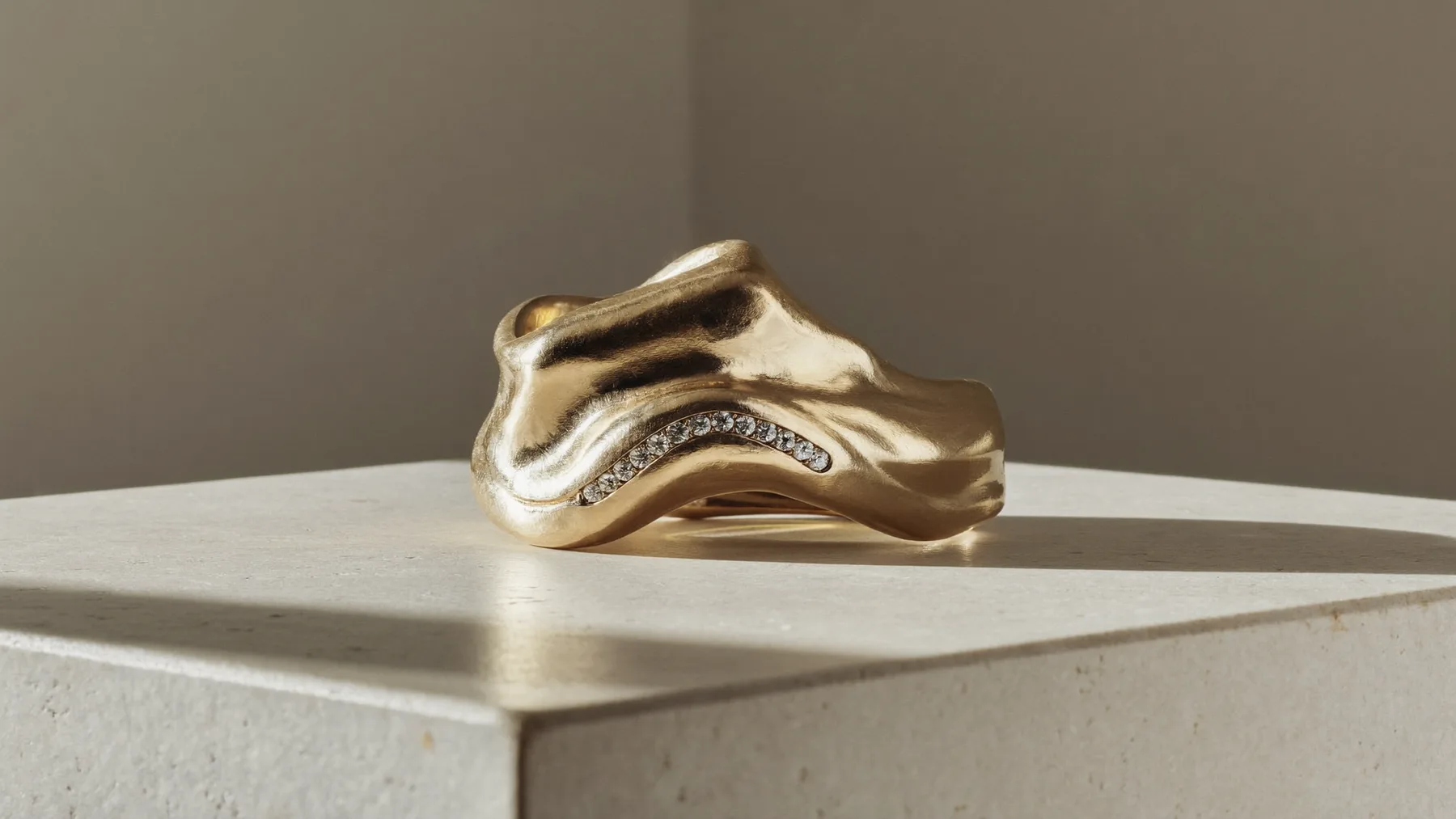
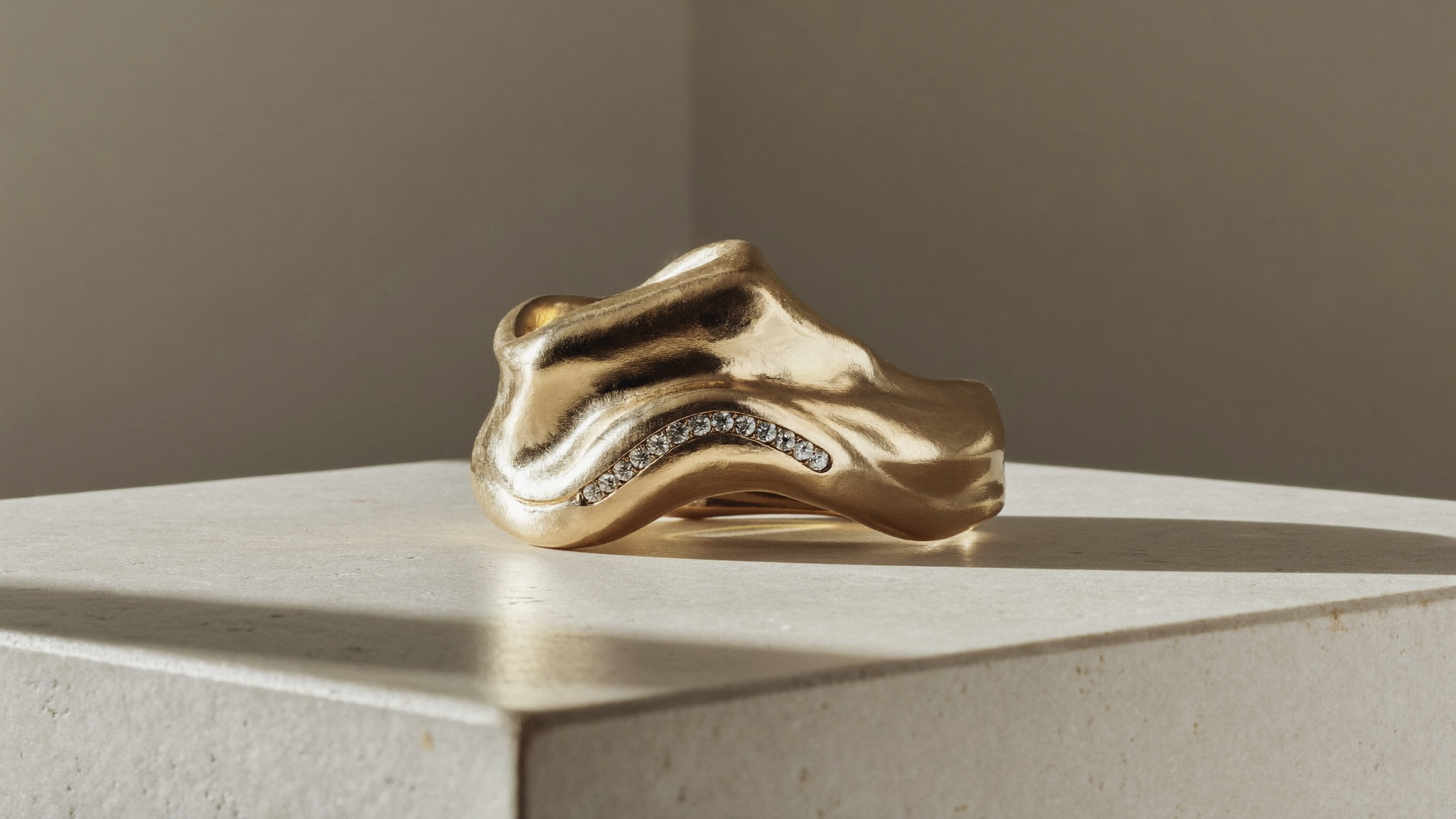
These are rings that read as objects first and settings second. Ribboned gold, architectural notches, forms that wrap rather than sit. The diamonds are present but subordinate to the silhouette. It is a different proposition from a solitaire, and it asks a different question: not what is it worth, but who made this.
Why Sculptural Rings Are 2026's Defining Shape
Sculptural rings took over in 2026 because a record gold price forced designers to compete on form rather than on mass.
The numbers behind that are stark. National Jeweler reports gold moving from roughly $2,625 an ounce in 2025 to a 2026 peak near $5,340, an effective doubling inside a year. Its separate analysis of jewelry demand cites World Gold Council data showing gold's 2025 annual average hit $3,431 an ounce, up 44% year over year and the highest annual average on record, while global jewelry demand by volume fell to a five-year low even as its total value reached a record $172 billion. People are buying fewer pieces and spending more on each one.
Designers responded by getting deliberate rather than getting smaller. Jennifer Shanker, founder and creative director of the jewelry showroom Muse, told National Jeweler that the price pressure had a creative effect: "If anything, it's pushed designers to be even more intentional." Some went further and reconsidered the material itself. Anna Maccieri of Anna Maccieri Rossi declined a supplier's offer of a lighter chain and moved into titanium, aluminium and ceramic with touches of gold instead, on the grounds that gold should not always be the protagonist.
The trend forecasters agree on the direction. WhoWhatWear opens its list of the six jewelry trends defining 2026 with sculptural forms, tracing the lineage back to Elsa Peretti's fluid, body-shaped work for Tiffany & Co. in the 1970s. That lineage matters, because it is the difference between a sculptural ring and a merely lumpy one.
What Separates a Good Sculptural Ring From a Lumpy One
A good sculptural ring resolves from every angle, which is the single test that separates designed volume from accidental bulk. Four things to check before you commit:
- It reads from three angles. Look at it face on, from the side, and from the wearer's own view looking down. A real design has an intentional silhouette in all three. A weak one only works in the product photograph.
- The diamonds follow the form. Stones should trace the line of the metal, not interrupt it. Pavé dropped onto a curve as decoration always looks added rather than designed.
- The setting has proper margins. GIA notes that pavé and bead-and-bright settings need a border of at least 0.50 mm, and channel settings need 1.00 mm walls. Stones crowded to the very edge of a sculpted surface will loosen.
- The inside is as finished as the outside. Sculptural exteriors tempt makers to leave the shank rough. Run a fingertip around the inner band. It should be smooth and comfortably domed.
Sculptural vs Classic: Which Ring Does What
Sculptural and classic rings solve different problems, and the honest answer is that most people eventually want one of each.
| Sculptural ring | Classic band or solitaire | |
|---|---|---|
| Reads as | An object, a design choice | A stone, a milestone |
| Best worn | Alone, with space either side | Stacked, layered, combined |
| Ages | By designer and era | Largely unchanged |
| Risk | Can date if the form is faddish | Can disappear into a stack |
| Buy it when | You already own the classics | You are building a foundation |
How to Wear a Sculptural Ring
Give a sculptural ring an empty finger on either side and let it do the work alone. Roomy's calls this part of the range the Collector's Edit, and the Reverie Diamond Sculptural Ring (from $1,050) is the clearest example: fluid ribbons of gold with bezel-set diamonds following the movement rather than sitting on top of it. The Atelier Diamond Sculptural Ring (from $1,650) is the maximal version, pavé worked into an abstract cluster.
If you want structure rather than flow, the architectural pieces are the other half of the category. The Crenelle Diamond Architectural Band (from $1,000) is built like a battlement, with diamonds filling each notch, and the Prism Diamond Band (from $800) sets emerald and princess cuts into a ribbed gold bar. For something between the two, the Petal Arch Diamond Band (from $850) repeats small gold arches across the finger, and the Comet Diamond Bypass Ring (from $1,200) opens rather than closes, which makes it the easiest sculptural shape to wear every day.
Two practical notes. Because the form is the point, the metal mark matters more than usual on a sculptural piece: our guide to gold hallmarks explains what 417, 585 and 750 mean and why the maker's mark beside them is the part to check. And if you want to combine a sculptural ring with slimmer bands rather than wear it solo, our ring stacking guide covers which profiles sit flush against a curved shank. For the broader context of where the volume trend came from, see our bold gold edit.
The real argument for a sculptural ring is not that it is fashionable. It is that a well-made one is the only piece in a jewelry box that someone will ask you about rather than compliment.
Frequently Asked Questions
What is a sculptural ring?
Are sculptural rings still in style in 2026?
How do you wear a sculptural ring without it looking too much?
Are sculptural rings a good investment?
Gold with something to say.
Sculptural solid gold rings set with lab grown, IGI certified diamonds, handcrafted to order.
Shop the Collection