Diamond Stud Earring Size, Decoded
Diamond stud earring size is the quietest decision in fine jewelry, and the one most often made by accident. Too small and the pair vanishes under a collar. Too large and a stud stops behaving like a stud at all.
The calculus changed in 2026, because the economics moved underneath it. Lab-grown diamonds put weight within reach that used to buy a third as much, and buyer expectations climbed with them. Wholesale lab-grown diamond prices fell 13% year over year in the second quarter of 2026, according to industry analyst Edahn Golan's price report covered by JCK, while U.S. specialty retail sales of lab-grown diamond jewelry rose 24% over the same quarter on data from the analytics firm Tenoris. More people are buying, and they are buying bigger. The size question is no longer about what you can afford. It is about what your ear can carry well.
That third number comes from the bridal side of the business, and it is the clearest signal of where size expectations have landed. The Knot's 2026 Real Weddings Study, which surveyed more than 10,000 U.S. couples and was reported by JCK, put the average engagement ring centre stone at 1.9 carats, with 61% of purchases now using a lab-grown stone. Ears follow hands by a season or two. The studs people ask for today are heavier than the ones they asked for in 2020.
What Diamond Stud Earring Size Actually Means
Diamond stud earring size is described by two different numbers that retailers use interchangeably and shoppers routinely confuse: carat weight per stone, and total carat weight across the pair. A listing that says "1 ct" may mean one carat in each ear or one carat split between them, and the difference is roughly a millimetre and a half of visible diamond.
Four measurements decide what a stud looks like on you:
- Carat weight per stone. The weight of one diamond. This is the number that governs how the pair actually reads on the ear.
- Total carat weight (ctw). Both stones added together. A 1.00 ctw pair is two half-carat stones, not two one-carat stones.
- Diameter in millimetres. The face-up measurement across the top of the stone. This is what your eye registers from a metre away.
- Setting height. How far the stone sits off the lobe. A deep basket lifts a stud forward and makes it catch more light; a low bezel tucks it flat.
Carat is a measure of weight rather than width, which is why two stones of identical weight can look different sizes. As GIA explains in its diamond quality factors, cut proportions determine how much of a diamond's weight sits in the visible crown versus hidden in the pavilion. A deep stone hides weight under the setting. A well-proportioned one spends it where you can see it. Our guide to excellent versus ideal cut grades covers how far that difference goes.
Diamond Stud Size by Carat Weight: A Millimetre Comparison
A well-cut round brilliant of 0.50 ct measures roughly 5.0 mm across, and each step up in weight buys progressively less width. The table below pairs the standard diameters with what each size honestly does on the ear.
| Per stone | Pair (ctw) | Approx. diameter | How it reads |
|---|---|---|---|
| 0.25 ct | 0.50 ctw | ~4.1 mm | A first diamond. Visible up close, invisible across a table. |
| 0.33 ct | 0.66 ctw | ~4.4 mm | The quiet everyday size. Reads at conversation distance without announcing itself. |
| 0.50 ct | 1.00 ctw | ~5.0 mm | The benchmark pair. Clearly a diamond, still appropriate at 9am. |
| 0.75 ct | 1.50 ctw | ~5.8 mm | Noticed across a room. Needs a secure back and a well-set post. |
| 1.00 ct | 2.00 ctw | ~6.5 mm | A statement. Fills a standard lobe edge to edge. |
Note the compression in that fourth column. Doubling the weight from 0.50 ct to 1.00 ct adds only about 1.5 mm of width, because weight grows with volume while the face you see grows with area. This is the single most useful thing to know before you spend: the jump from 0.33 ct to 0.50 ct buys far more visible difference per dollar than the jump from 0.75 ct to 1.00 ct. If you want the same maths applied across fancy shapes, our diamond carat size chart by shape lays out the millimetre equivalents.
How the Setting Changes the Size You See
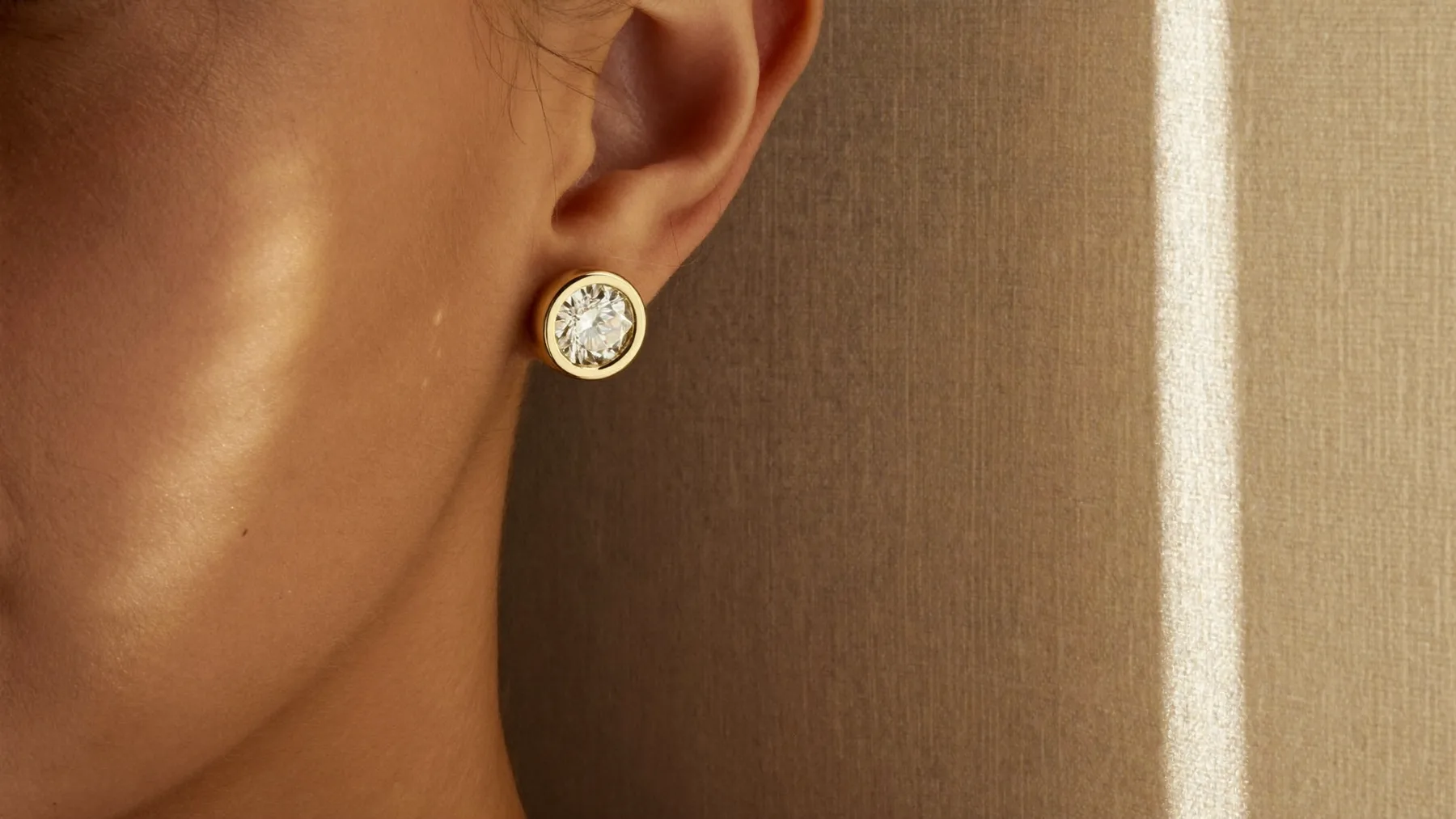
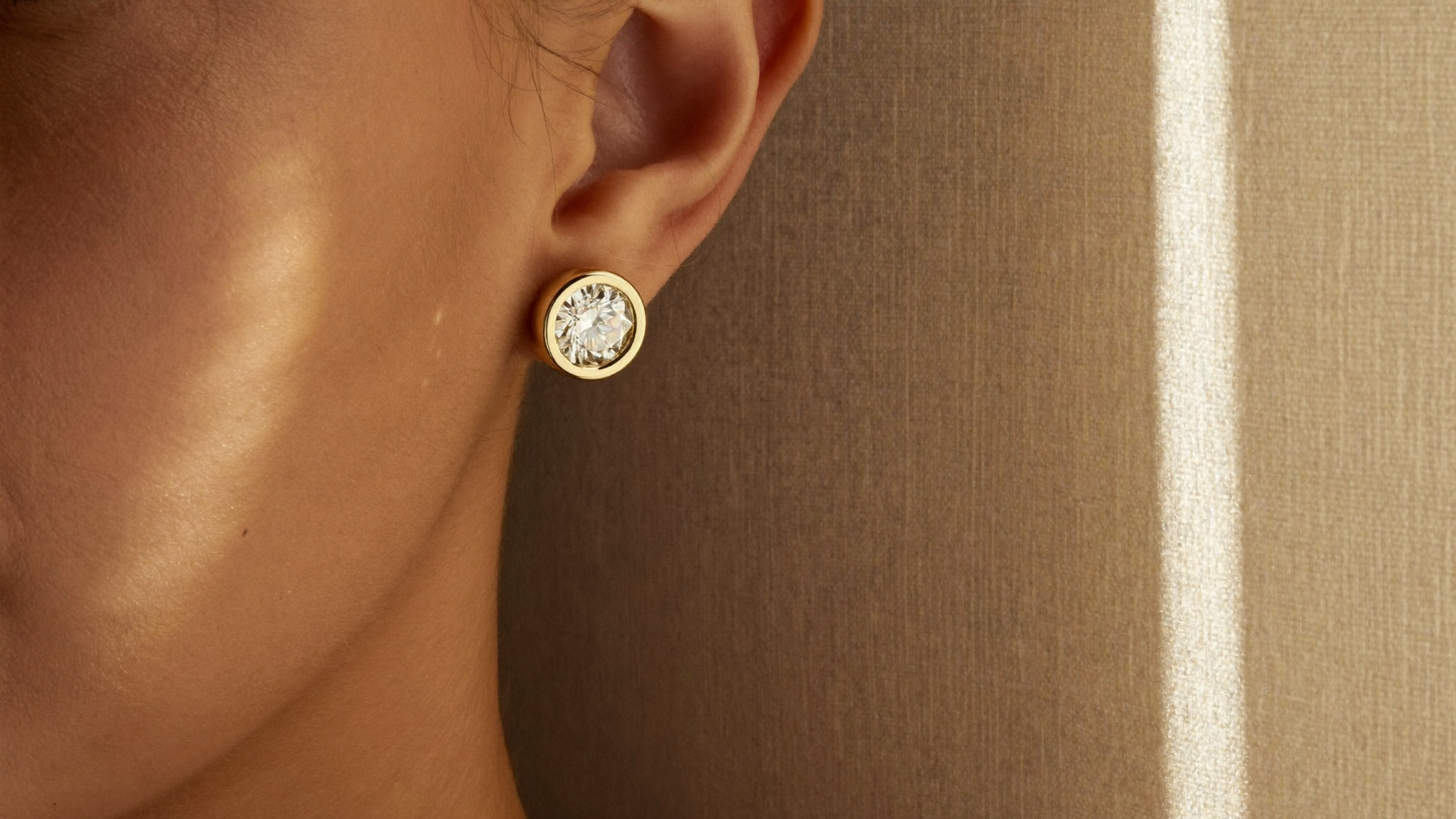
Setting style can change a stud's apparent size by a full carat step without changing the diamond at all. A halo of pave stones adds visible diameter around a modest centre; a bezel of solid gold reads as mass even when the stone inside is small; an open prong basket does the opposite and lets the diamond float with nothing competing.
If you want the ear to look fuller without buying more weight, a designed setting is the more intelligent purchase. The Starlight Portal Diamond Stud Earrings (from $1,500) ring an open centre with pave, so the pair reads substantially larger than its centre stone alone. The Three Stone Diamond Stud Earrings (from $450) distribute weight across three round stones instead of one, which covers more lobe for the same total carat. The Emerald Ribbon Diamond Stud Earrings (from $500) use sculpted gold to carry the silhouette, letting a step-cut stone sit at its own scale.
For smaller lobes, or for a second piercing, scale down deliberately rather than apologetically. The Blossom Grace Mismatched Diamond Earrings (from $350) are built on asymmetry, which suits an ear that already carries something else, and the Butterfly Diamond Stud Earrings (from $450) use pave across a shaped wing rather than a single stone. Every piece is set with IGI and Roomy's certified lab-grown diamonds in solid 10, 14 or 18kt gold.
What Diamond Studs Cost in 2026
Solid gold lab-grown diamond studs start around $350 a pair and run past $2,500 for sculptural and multi-stone designs, with carat weight, gold karat and setting complexity driving the spread. Two of those three are worth paying up for. The third, raw carat weight, is where buyers most often overspend for the least visible return.
The market has drifted the same direction. Golan's data shows wholesale prices for 1 ct rounds ticking up 1% in the second quarter even as the overall index fell, and his explanation is blunt: "Demand for 1 ct. stones has slowed as 2 and 3 ct. diamonds have become more affordable," he wrote in the report covered by JCK. Buyers are chasing bigger stones because they finally can.
Studs remain the category's steadiest seller through that churn. Sherry Smith of The Retail Smiths told National Jeweler that diamond jewelry accounts for roughly 42% of a jeweler's annual sales, with studs among the top-selling items at retailers of every size and lab-grown steadily gaining ground on natural within that category. A good pair of studs is not a trend purchase. It is the piece that outlasts every other decision in the box. If your ear already carries gold in another tone, our edit on mixed metal jewelry explains how to let a stud in one metal sit comfortably beside a stack in another.
Frequently Asked Questions
What size diamond stud earrings should I buy for everyday wear?
Does ctw mean each earring or the pair together?
Is 1 carat total weight too small for stud earrings?
Are lab grown diamond studs worth it in 2026?
Find the size that suits your ear
IGI-certified lab-grown diamonds, set by hand in solid 10, 14 and 18kt gold.
Shop the Collection