Your Necklace Length Guide, Inch by Inch
Most necklaces are returned for one reason, and it is almost never the diamond. It is the length. A necklace length guide is the least glamorous page in fine jewelry and the one that decides whether a pendant sits where you imagined it or disappears under a collar.
Chain length is measured in inches, end to end, clasp included. Two inches is the difference between a piece that frames the throat and a piece that lands mid sternum. That gap matters more now than it did five years ago, because the way people wear diamonds has changed: single statement pendants have given way to deliberately stacked sets, and stacked sets only work when the lengths are chosen rather than inherited.
The numbers behind those figures are worth knowing before you choose a chain. Reporting on a new market study by analyst Edahn Golan, JCK put global retail sales of lab-grown diamond jewelry at an estimated $23.8 billion, with lab-grown accounting for 20.5% of US diamond jewelry units sold. On the metal side, the World Gold Council reported an average gold price of US$4,262 per ounce in the third quarter of 2026, with global gold jewellery demand down 17% year on year to 313 tonnes. Translation: the stone is more accessible than it has ever been, and the gold around it is not. Length is where those two facts meet, because a 24 inch chain is simply more gold than a 16 inch chain.
What Each Necklace Length Actually Looks Like
Standard necklace lengths run from 14 to 36 inches, and the four that cover almost every fine jewelry purchase are 16, 18, 20 and 24 inches. The chart below maps each length to where it falls on an average adult frame, measured from the base of the neck down.
| Length | Where it sits | Best for |
|---|---|---|
| 16 inch | At the base of the throat, on or just below the collarbone | Open necklines, a top layer in a stack, small bezel or solitaire pendants |
| 18 inch | One to two inches below the collarbone, on the upper chest | The default for a single diamond pendant. Works under and over most necklines |
| 20 inch | Just above the top of the bust line | Larger or sculptural pendants, higher necklines, the middle of a three-piece layer |
| 24 inch | Mid sternum, below the bust line | Long elegant drop, worn over knitwear and tailoring, the anchor of a layered stack |
Two caveats keep this honest. Height and frame shift every one of these numbers: on a petite frame an 18 inch chain behaves like a 16, and on a taller or fuller frame it behaves like a 20. And a heavy pendant pulls a chain down by a few millimetres, which is why the same 18 inch chain reads differently with a Liquid Diamonds Marquise Flow Pendant (from $250) than with a Oval Diamond Solitaire Pendant (from $2,000).
How to Measure Your Necklace Length at Home
You can find your correct necklace length in under two minutes with a piece of string and a ruler. The method below is the one our workshop uses when a client cannot come in.
- Measure a necklace you already own. Lay it flat, clasp closed, and measure the full loop end to end. This is the fastest and most accurate route, because you already know how that piece wears.
- Or use string. Drape a length of string around your neck, adjust until the lowest point sits exactly where you want the pendant, mark it, then lay it flat against a ruler.
- Measure your neck, then add. Wrap a tape measure snugly around the base of your neck. Add 2 inches for a close collarbone fit, 4 inches for an 18 inch style drop, and 6 to 8 inches for a longer chain.
- Account for the pendant. A pendant adds its own drop. A 25mm pendant on an 18 inch chain finishes roughly where a bare 20 inch chain would.
- Check it against your necklines. Measure while wearing the collar you wear most. A length that works with a crewneck often disappears under a turtleneck.
If you are sizing more than one piece, the same logic applies across the wrist. Our bracelet size guide uses an identical measure-then-add method, and the two together will keep a full set proportional.
Necklace Length Guide for Pendants and Layering
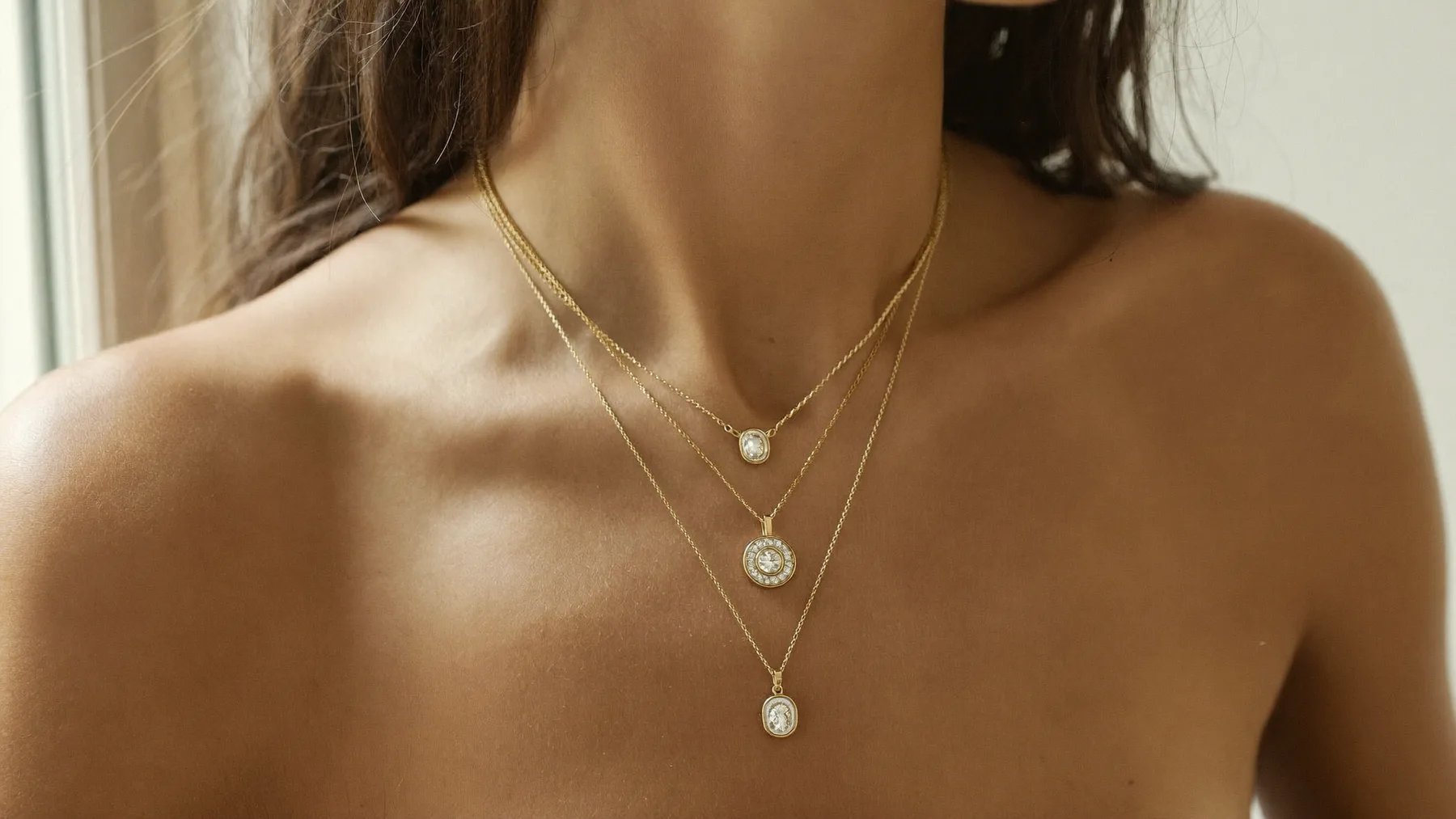
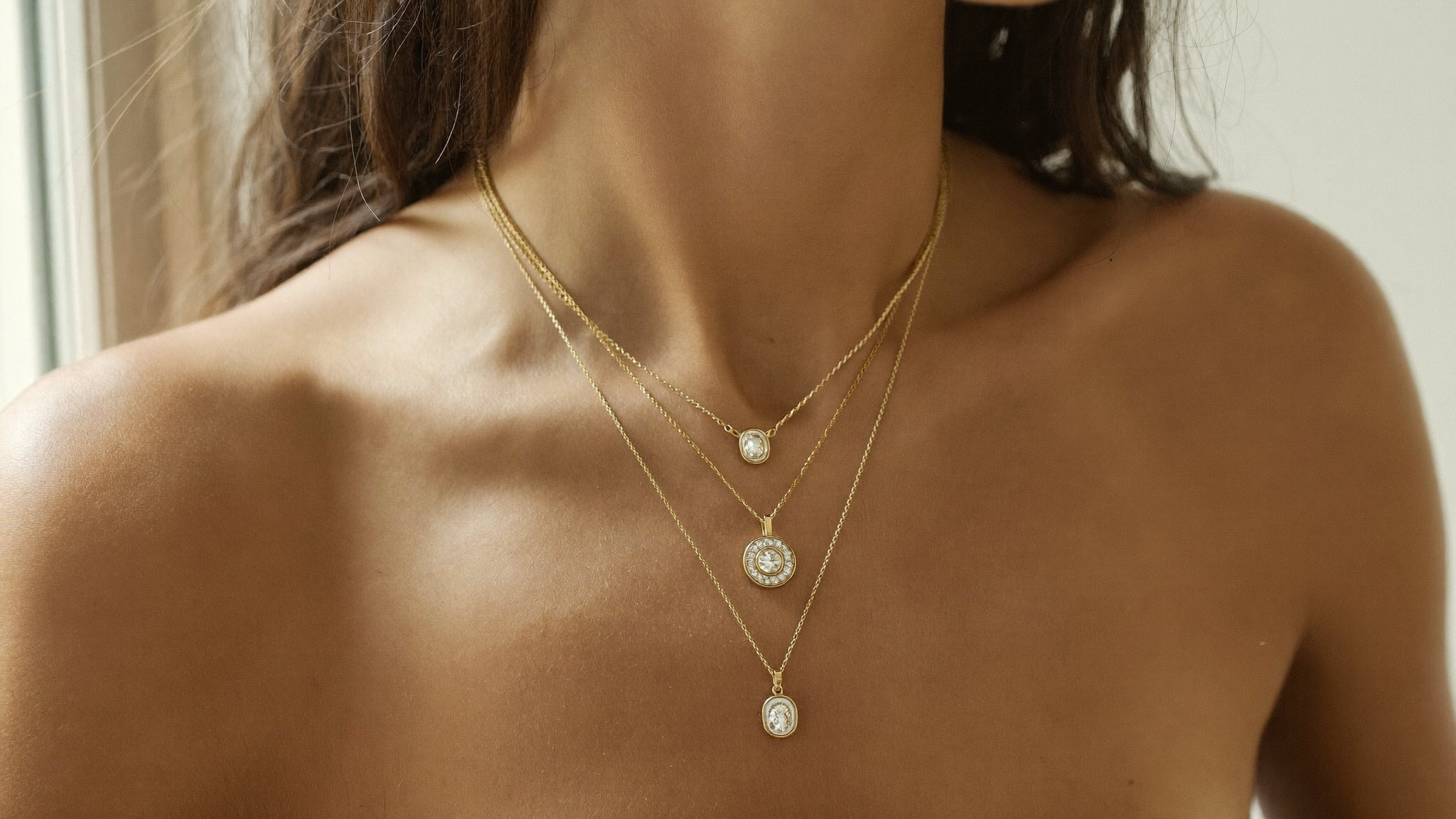
For layering, space each chain in the stack 2 to 4 inches apart so no two pendants collide. That single rule governs most of what follows. A 16, 18 and 20 inch trio reads tight and intentional; a 16, 20 and 24 inch trio reads relaxed and editorial; anything closer than 2 inches tangles.
Layering has moved from a styling idea to a buying pattern. In its holiday trend reporting, National Jeweler described layered looks and personalization as the defining diamond trends heading into the season, and quoted Amanda Gizzi of the trade association Jewelers of America on where the category is going: "It's the natural evolution of a trend cycle." JCK made the same observation from the design side, writing in its chain report that "grouping several necklaces together has never really left us."
Build a stack with varied scale rather than three versions of the same idea. A fine 16 inch chain carrying the Heart Diamond Pendant (from $850) at the throat, an 18 inch chain holding the Halo Round Diamond Pendant (from $850), and a 20 inch chain carrying the Starlight Portal Diamond Necklace (from $1,700) gives you three distinct silhouettes at three distinct heights. If you prefer one piece doing all the work, the Ribbon & Baguette Diamond Statement Necklace (from $2,300) is designed to sit alone at 16 to 18 inches. For an uninterrupted line of diamonds rather than a pendant, our guide to the riviere tennis necklace covers how that silhouette differs in both length and weight.
Chain Weight, Gold Price and What You Actually Pay
Length changes price because a chain is sold by the gram of solid gold it contains, not by the inch of design. Adding 6 inches to a chain can add roughly a third more metal, and at the gold prices the World Gold Council recorded this year that difference is visible on an invoice rather than theoretical.
Three factors set what a chain costs beyond its length. Karat is the first: 10kt, 14kt and 18kt contain progressively more pure gold, so an 18kt 20 inch chain can cost meaningfully more than the same chain in 10kt. Link style is the second, because a solid cable or rope link uses more metal than a hollow or fine box link of the same length. Clasp and findings are the third, and are where cheap necklaces usually fail first. Every Roomy's chain is solid 10kt, 14kt or 18kt gold, and every diamond we set is lab-grown and IGI certified, so the only variable you are paying for across lengths is the metal itself.
A practical consequence: if your budget is fixed, buy a shorter chain in a higher karat rather than a longer chain in a lower one. You can always add length later with a separate layering chain. If the metal colour is still undecided, our companion piece on whether rose gold is still in style compares rose, yellow and white gold on price, upkeep and how each wears over time.
Frequently Asked Questions
What is the most common necklace length for women?
Is an 18 inch necklace too short for a pendant?
How do I measure my necklace length at home?
What necklace lengths work best for layering?
Find the length that sits exactly where you want it
Solid 10kt, 14kt and 18kt gold chains set with IGI certified lab-grown diamonds, finished by hand in our workshop.
Shop the Collection