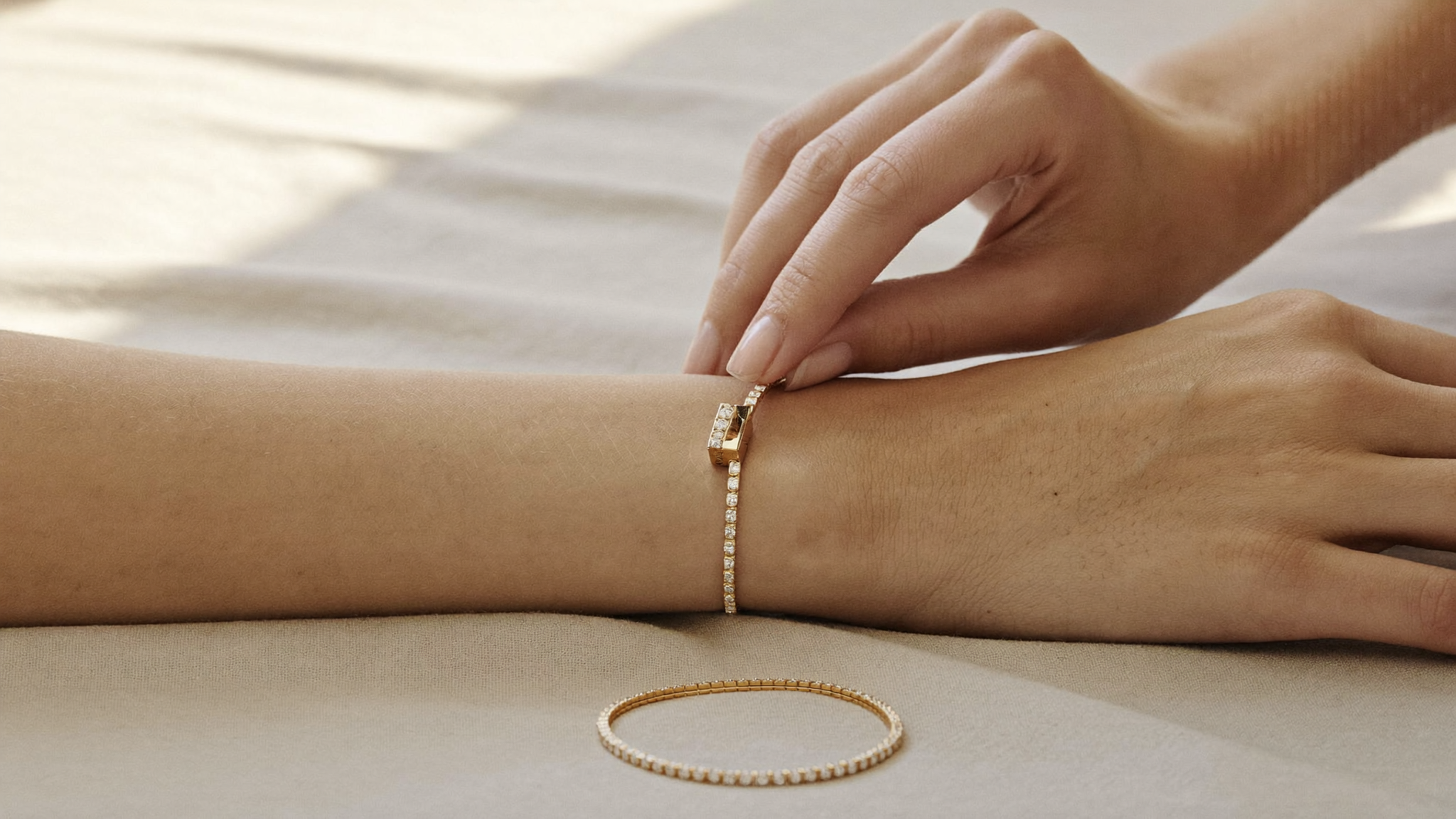
A Bracelet Size Guide That Actually Fits
Most of what passes for a bracelet size guide stops at a chart. The chart is the easy part. The harder part is knowing how much room a diamond line bracelet needs to sit where it should, and why the same 7 inch length reads elegant on one wrist and sloppy on the next.
Fit is the single thing that decides whether a diamond bracelet gets worn daily or lives in a drawer. A piece that is half an inch too long spins, hides its clasp on the underside of the wrist, and catches on cuffs. A piece that is half an inch too short digs in and refuses to drape. Below is the method we use, the wrist to length chart we size by, and the honest limits of guessing someone else's wrist in gift season.
Those numbers set the stakes. The National Retail Federation forecasts $1.013 trillion in US holiday sales across November and December 2026, up 4.2 percent on last year. The NRF also found that American shoppers returned $849.9 billion of merchandise, equal to 15.8 percent of annual sales. Jewelry sits squarely in that flow, and fit is one of the few return reasons a buyer can eliminate before checkout.
How to Measure Your Wrist for a Bracelet
Measure your wrist with a strip of paper and a ruler, just below the wrist bone, pulled snug but not tight. That single measurement, taken correctly, is the input for every sizing decision that follows. A soft tailor's tape works too, though paper is more accurate because it does not stretch.
- Cut a strip of paper roughly 8 inches long and half an inch wide.
- Wrap it around the wrist just below the wrist bone, on the side closest to the hand, where a bracelet naturally settles.
- Pull it snug so it sits flat against skin without compressing it, then mark where the end overlaps.
- Lay the strip flat and read the measurement to the nearest eighth of an inch. That is your wrist measurement, not your bracelet size.
Measure at the end of the day. Wrists swell slightly through the day and in warm weather, and a bracelet sized to a 7am wrist can feel tight by evening. If you are between two eighths, round up.
Bracelet Size Chart: Wrist Measurement to Bracelet Length
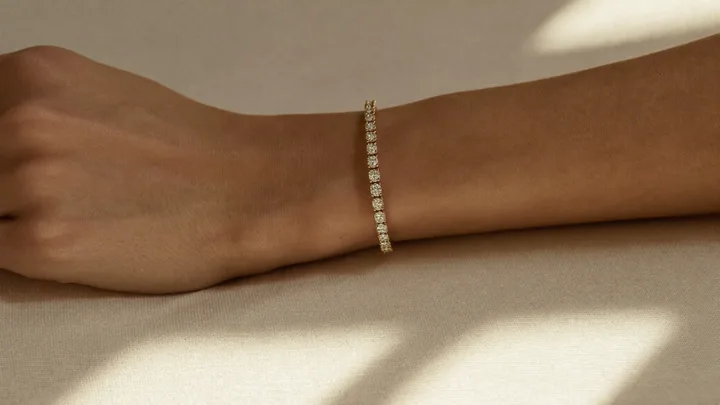
Bracelet size is your wrist measurement plus an allowance, and the allowance is what the chart below sets. For a diamond line bracelet we add roughly half an inch for a close fit and up to one inch for a relaxed drape, because a line bracelet needs to rotate slightly to catch light rather than sit locked in place like a watch.
| Wrist measurement | Bracelet length | How it wears |
|---|---|---|
| 5.5 to 6.0 in | 6.5 in | Close and controlled. Sits high on the wrist, minimal movement. |
| 6.0 to 6.5 in | 7.0 in | The standard. Slight drape, clasp stays on top. |
| 6.5 to 7.0 in | 7.5 in | Standard with movement. The most flattering fit for most adults. |
| 7.0 to 7.5 in | 8.0 in | Relaxed. Falls onto the hand when the arm is lowered. |
| 7.5 to 8.0 in | 8.5 in | Generous. Best with a wider link or a safety chain. |
Seven inches is the length most adult women land on, which is why it is the default across the category. It is a default, not a verdict. A 6.75 inch wrist in a 7 inch bracelet wears beautifully; a 7.5 inch wrist in the same piece will feel like a handcuff by dinner. If you want the full picture on what you are paying for at each carat weight, our diamond tennis bracelet price guide breaks the bands down.
Why Diamond Tennis Bracelet Fit Is Different
A diamond tennis bracelet is sized more precisely than a bangle or a chain because its links are rigid and its stones face one direction. A chain can twist without consequence. A line bracelet that twists turns its diamonds toward your skin and shows you a row of gold galleries instead.
Carat weight changes the equation too. A lighter line like the Opale Round Diamond Tennis Bracelet (from $550) or the Éclat Emerald Diamond Tennis Bracelet (from $500) is light enough to sit anywhere on the wrist, so a half inch of extra length reads as drape. Heavier pieces such as the Gloire Round Diamond Tennis Bracelet (from $3,200) at 1.19 carats total weight carry enough mass that the same half inch lets the bracelet slide onto the back of the hand. Heavier means tighter.
Every Roomy's line bracelet is built in solid 10kt, 14kt or 18kt gold around IGI certified lab grown diamonds, and the metal choice does not change the sizing. It changes the weight, and weight is what you feel.
Buying a Diamond Bracelet as a Gift Without Knowing Her Size
If you cannot measure the recipient's wrist, borrow a bracelet she already wears and measure that instead. Lay it flat in a circle, measure the interior from end to end including the clasp, and you have her working length without asking a single question.
When that is not possible, three options reduce the risk, in order of preference:
- Match an existing piece. Measuring a bracelet she wears is the only method that is effectively exact.
- Default to 7 inches. It is the most common adult length and the easiest to adjust in either direction.
- Choose a style with forgiveness. A finer line such as the Rivière Round Diamond Tennis Bracelet (from $1,600) or the Aurore Round Diamond Tennis Bracelet (from $1,450) tolerates a quarter inch of error far better than a wide statement line does.
Diamond jewelry is a disproportionate share of what jewelers sell in this window. National Jeweler reported in September 2026 that diamond jewelry accounts for roughly 42 percent of a jeweler's annual sales, citing Sherry Smith of The Retail Smiths, with line bracelets and rivière necklaces leading the season's marketing. If you are buying into the most competitive category of the year, fit is the cheapest advantage available. Once it fits, the next question is what you wear it with, and our guide to how to stack bracelets covers that.
Clasps, Safety Chains, and Keeping It On the Wrist
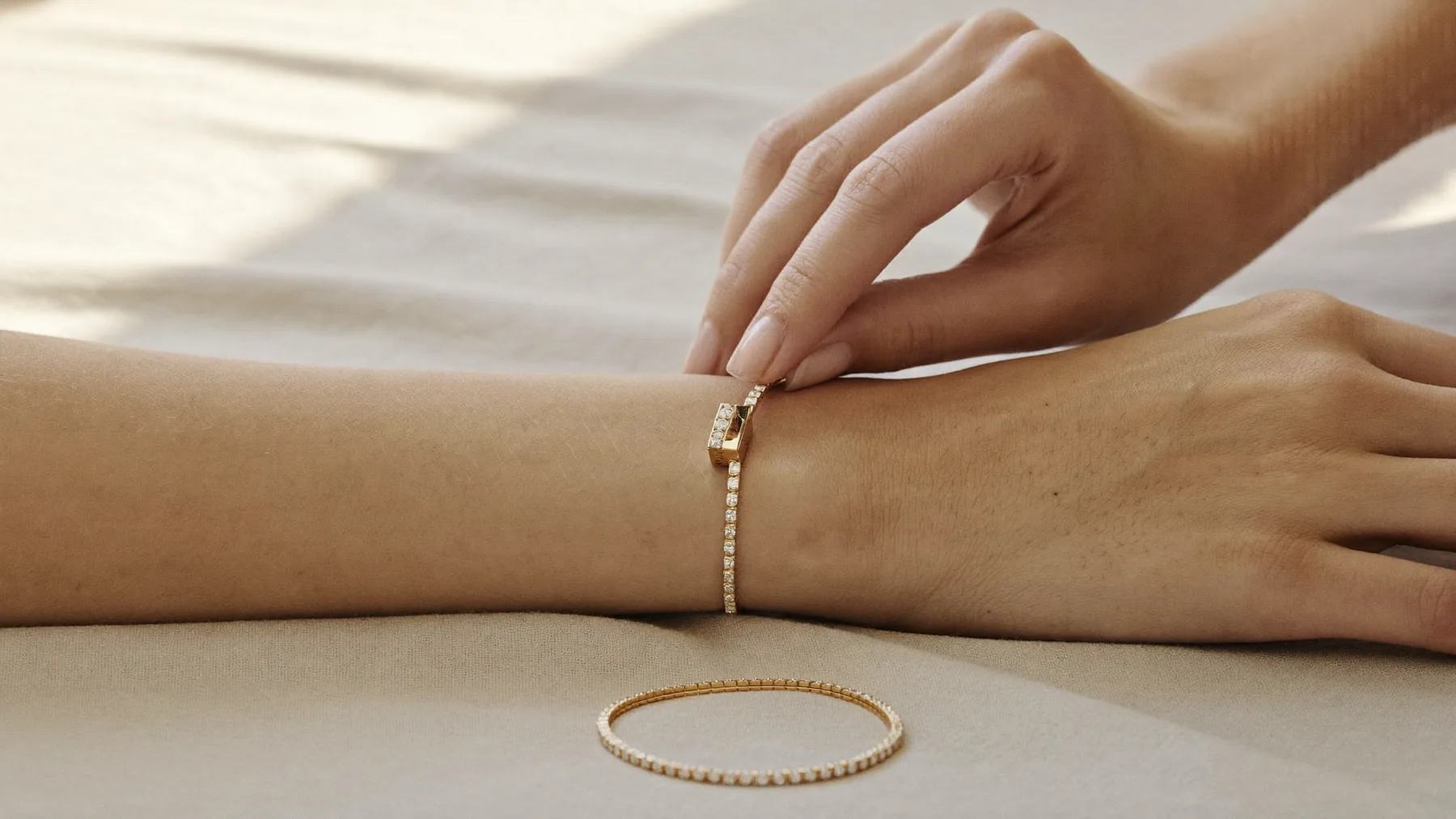
A box clasp with a figure eight safety catch is the standard closure on a fine line bracelet, and the safety catch is not decorative. It is the second point of failure that keeps a bracelet on your arm when the first one opens against a coat sleeve. Check that the catch clicks, not just rests.
Correct fit also protects the piece. A bracelet with too much slack swings against door frames and desks, which is how stones loosen. The GIA is direct about the maintenance schedule that follows: "Jewelry should be checked every six months and cleaned frequently," as GIA puts it in its jewelry care guidance, noting that many jewelers offer those check ups free of charge. Twice a year, have the clasp and the stone settings looked at. It takes minutes and it is the difference between a repair and a loss.
If sizing at home is new to you, the same measure twice logic applies to rings, and our guide on how to measure ring size at home uses a nearly identical paper strip method.
Frequently Asked Questions
How do I measure my wrist for a bracelet at home?
What is the most common bracelet size for women?
Should a diamond tennis bracelet be loose or tight?
Can a diamond tennis bracelet be resized?
Sized for your wrist, not an average
Solid gold line bracelets set with IGI certified lab grown diamonds, built in 10kt, 14kt and 18kt.
Shop Bracelets