How to Stack Bracelets Without the Noise
The wrist is having its turn. After two seasons in which the neck did all the work, the conversation about how to stack bracelets has moved from maximalism to something far more disciplined: three pieces, one idea, nothing competing.
A good stack is not an accumulation. It is a composition that happens to be made of separate objects, and the difference between the two is visible from across a room. Below is the framework we use, the spacing that makes it read as intentional, and the diamond line bracelets that layer cleanly instead of fighting each other for the same inch of skin.
The numbers explain why the wrist is suddenly crowded. National Jeweler reported in September 2026 that diamond jewelry makes up roughly 42 percent of a jeweler's annual sales, per Sherry Smith of The Retail Smiths, with layered looks named as the season's defining trend. Fortune put spot gold at $3,907 an ounce on October 30, 2026, which is why the slim profile is winning over the heavy bangle. And the National Retail Federation expects US holiday sales to rise 4.2 percent to $1.013 trillion this November and December.
How to Stack Bracelets: The Three Piece Rule
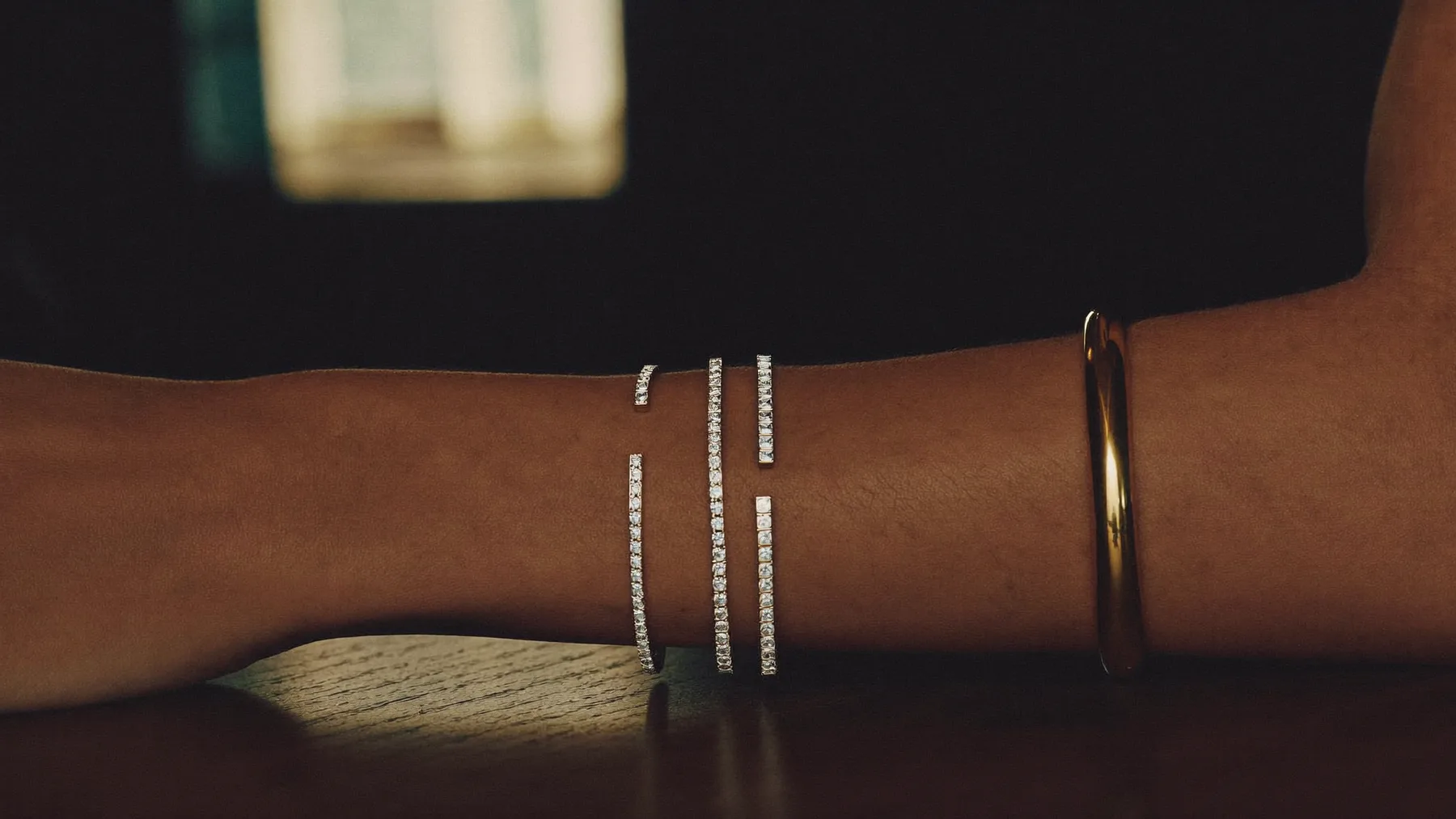
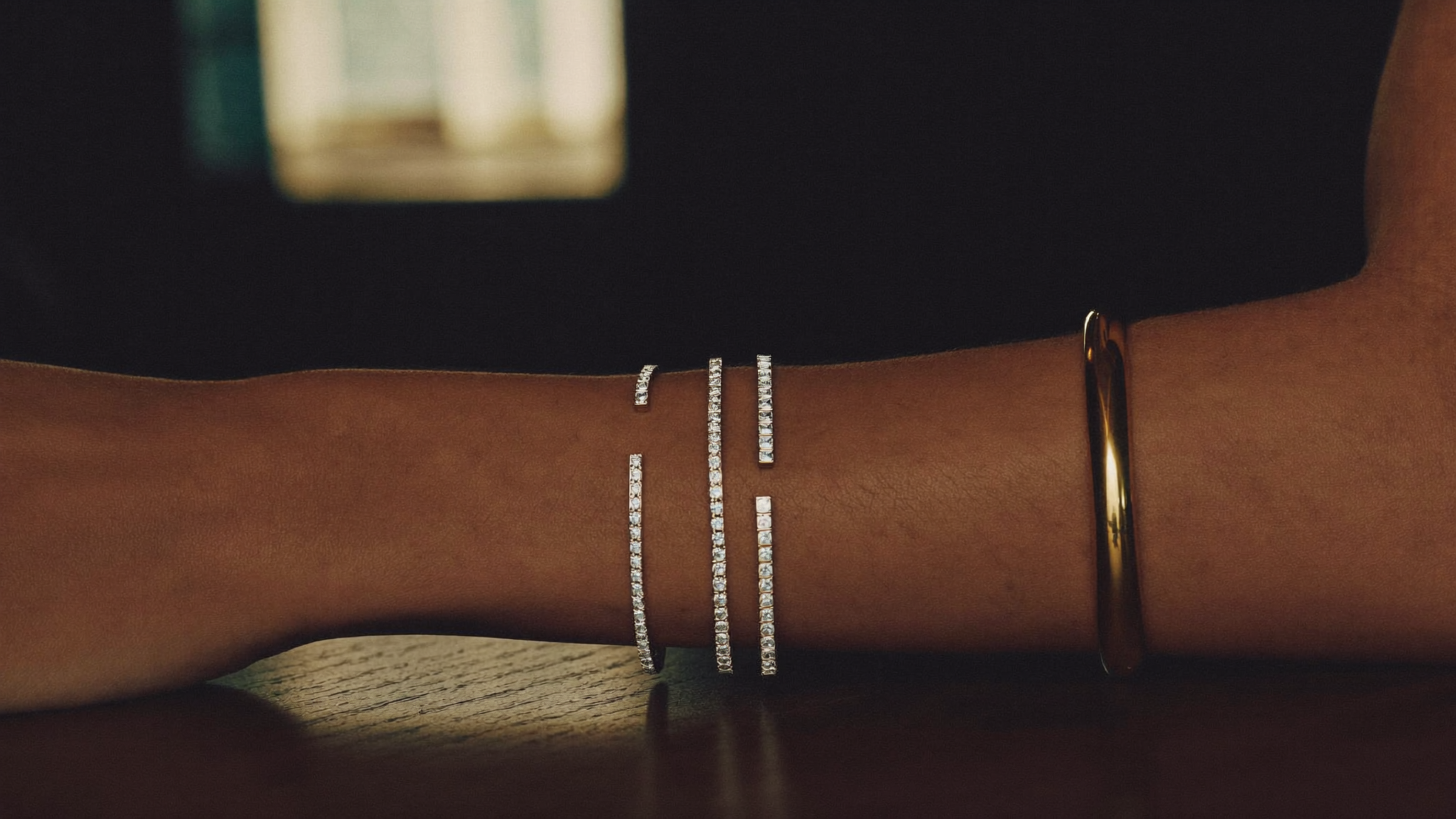
Stack three bracelets, not four, and give each one a different job. Three is the point at which a wrist reads as styled rather than either bare or busy, and assigning each piece a role is what stops the group from collapsing into visual noise.
- The anchor. The widest or highest carat piece. It sets the stack's weight and sits closest to the hand.
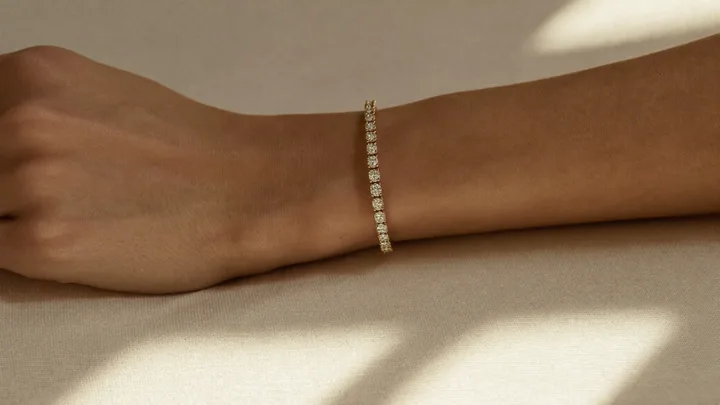
- The line. A slim diamond bracelet that carries continuous light along the wrist and does the actual sparkling.
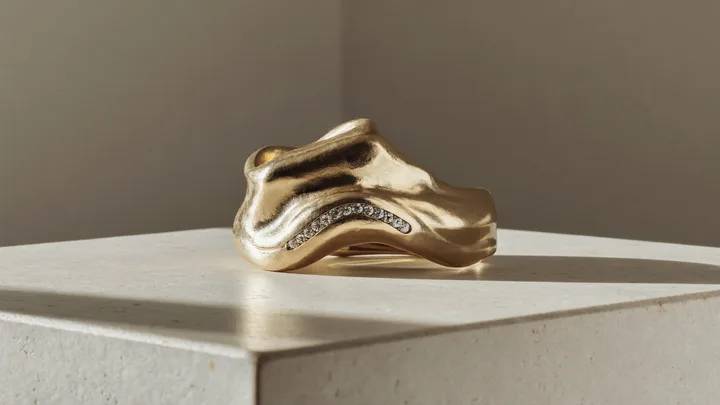
- The quiet one. A plain gold cuff, chain or thin band with no stones, which gives the eye somewhere to rest.
Drop any one of the three and the stack loses its logic. Two lines with no quiet piece reads as indecision. Two quiet pieces with one line reads as an afterthought. The anchor, the line and the rest are the whole framework.
Spacing, Width, and Why Most Stacks Look Cluttered
Cluttered stacks are almost always a spacing problem, not a quantity problem. Three bracelets of near identical width, sitting flush against one another, merge into a single indistinct band and lose every individual line.
Vary width deliberately. A 1.5mm line next to a 3mm line next to a 5mm cuff gives the eye three distinct events. Keep widths within one millimetre of each other and you have made one thick bracelet by accident. The same applies to length: a fraction of slack between pieces lets each one move independently, which is the entire visual appeal. Our bracelet size guide covers how to get that slack right before you start layering.
Three Diamond Bracelet Stack Formulas
Start from a formula rather than from your jewelry box, because a stack built by addition almost never resolves. These three cover most wrists and most evenings.
| Formula | What goes on | Reads as |
|---|---|---|
| The Line Stack | Two slim diamond lines in the same metal, one plain gold cuff | Tonal and quiet. Office, daytime, every day. |
| The Graduated Stack | A high carat anchor, a mid weight line, a fine line | Deliberate and expensive. Evening and occasion. |
| The Shape Stack | One fancy shape line, one round brilliant line, one cuff | Collected over time. The most personal of the three. |
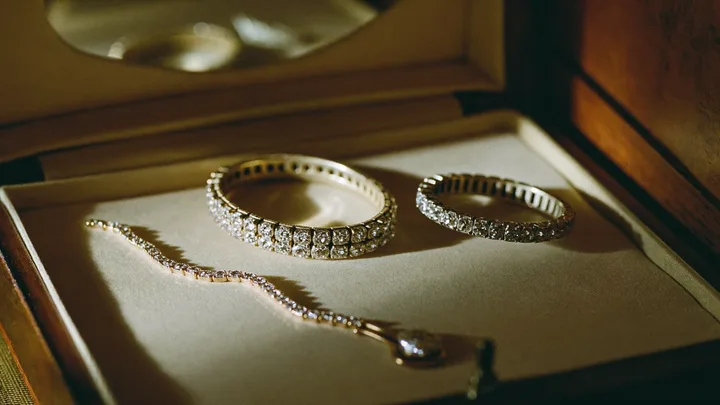
For the Line Stack, two fine rounds such as the Aurore Round Diamond Tennis Bracelet (from $1,450) and the Céleste Round Diamond Tennis Bracelet (from $1,700) sit together without either one dominating. Add a plain polished piece such as the Stardust Cuff (from $66.50), an 18K gold plated cuff from our Everyday Edit, as the quiet third.
For the Graduated Stack, anchor with the Étoile Round Diamond Tennis Bracelet (from $3,150) at 0.74 carats total weight, then step down through the Nuage Round Diamond Tennis Bracelet (from $3,000). For the Shape Stack, the Lumière Pear Diamond Tennis Bracelet (from $6,550) brings two carats of pear cut against a round line and changes the rhythm entirely.
Mixing Metals and Keeping the Stack Coherent
Mixing yellow, rose and white gold in one stack works when one metal clearly leads and the others support. Two metals at equal visual weight look undecided; a three to one ratio looks like a choice. If you are new to it, our guide on mixing metals jewelry goes deeper.
Jewelers describe the appeal in terms of permanence rather than variety. "It's really about creating a signature look, and a bracelet feel that they can wear and keep on," said Jade Trau, the diamantaire and founder of her namesake house, speaking to National Jeweler about holiday bracelet demand. A stack you take off every night is a costume. A stack you leave on becomes a signature.
Trade press has watched the same shift. JCK's Victoria Gomelsky reported from Las Vegas Jewelry Week in June 2026 that tennis bracelets, necklaces and earrings strung with diamonds of varying shapes had become, in her words, suddenly de rigueur. Varying the shape is now the point.
Wearing the Stack With a Watch
Put the watch on one wrist and the stack on the other, or if they must share, keep only one diamond line beside it. A watch is already an anchor, so adding a second heavy piece beside it gives the wrist two competing focal points and no hierarchy.
For evening, the restraint pays off. A graduated diamond stack against a bare second wrist is the whole look, and it belongs to the same understated register we covered in our piece on quiet luxury jewelry. Every Roomy's line bracelet is handcrafted in solid 10kt, 14kt or 18kt gold with IGI certified lab grown diamonds, which is what lets a stack of three stay under the weight a wrist will tolerate for twelve hours.
Frequently Asked Questions
How many bracelets should you stack on one wrist?
Can you stack a diamond tennis bracelet with a watch?
Is it okay to mix gold and silver bracelets in a stack?
How do you stop stacked bracelets from tangling?
Build the stack one line at a time
Solid gold diamond line bracelets in 10kt, 14kt and 18kt, each stone IGI certified and lab grown.
Shop Bracelets